The Shield That Became a Sword
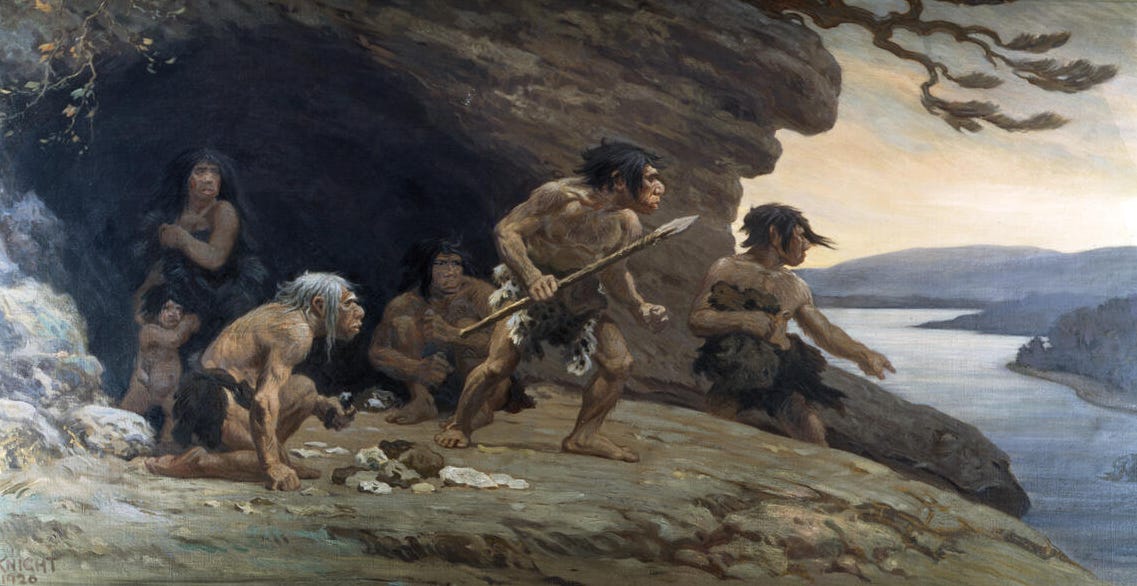
Caveman (Wikipedia)
Epistemic status: the origin story in Section I is the one I find most plausible, but it’s contested, and I flag where the evidence is thin. The argument in the later sections doesn’t depend on it, and it applies to secular ideologies as much as to religious ones.
I.
The best shield available
Imagine you’re a behavioural economist who has been asked to design a civilization from scratch. The problem statement is fairly clean: coordinate ten thousand selfish primates whose default loyalty is to their own families, and get them to cooperate at scale without centralized oversight or meaningful enforcement. You have ten thousand years.
Behavioural science has existed for about fifty years. Our ancestors, without game theory, Kahneman, or Elinor Ostrom, solved this problem with what I think is one of the most elegant pieces of cognitive engineering in human history.
There’s a limit on how many stable relationships a primate brain can maintain. Robin Dunbar put it around 150. The number itself is contested (a reanalysis put its 95% confidence interval anywhere from 4 to 520), but some limit clearly exists, and the argument only needs that. Past it, gossip and communal memory stop being enough to keep free riders from chewing through the commons.
The solution was invisible beings watching every move (cosmic CCTV, if you like), plus heaven and hell to calibrate the incentives more effectively than any police force could. Add calendars and rituals that synchronize people in time, and you get fifty thousand strangers praying at the same hour, fasting on the same day, and facing the same direction. That was arguably the earliest distributed consensus protocol humanity ever ran. I should say that this is the story I find most plausible and that it isn’t a settled result: Ara Norenzayan’s “Big Gods” argument, that moralizing gods made large-scale cooperation possible, has serious critics, and whether moralizing gods came before large societies or after them is still argued over.
Some of the data fits, with caveats. Robert Putnam and David Campbell found in American Grace that regular churchgoers give and volunteer more than other Americans, and that the networks built in congregations, more than theology, explain most of the difference. In a large study of American nurses, women who attended religious services at least weekly had a suicide rate roughly five times lower than women who never attended (VanderWeele et al., 2016), though that’s observational. The experimental evidence is shakier: the well-known finding that religious primes make people more generous in economic games has failed to replicate.
Religion was also the original safety net. Churches fed the hungry long before BPJS, pesantren taught children for free long before UNICEF, and monasteries tended people who would otherwise have died alone long before anyone said “hospice”. For hundreds of millions of people today, this is still how things work. Anyone who says religion is just stupidity and a con hasn’t thought about it long enough.
II.
Sacred values
The same machinery that makes religion such a good shield has a property that turns dangerous at scale, and the research literature has a name for it: sacred values.
Most of what we value can be traded. You’ll give up some salary for a shorter commute, or some safety for a cheaper car, and you don’t feel dirty doing it. A sacred value is one a community places beyond trade-offs. Philip Tetlock calls proposals to trade one a taboo trade-off, and the typical response is moral outrage rather than a counteroffer. Merely being asked what price you’d take can feel like an insult.
That property is the whole trick behind coordination at scale, since a commitment nobody will renegotiate is a commitment everyone can rely on. It becomes a problem when the sacred label lands on something that is, physically, divisible.
Peel the religious labels off the Israel-Palestine conflict and a large part of what’s left is a property dispute, a fight over land and resources. In basic game theory land is a divisible good: you can cut it up, trade it, or carve out a joint economic zone where both sides win. Introduce the variable “Holy Land”, and a deed signed by God, and the dispute becomes a theological absolute in which every trade-off gets relabelled as apostasy or treason against heaven. This isn’t the only way to read the conflict, which has thick colonial, ethnic, and geopolitical layers I’m not engaging with here (I’ve written about its structure separately), but the sacred component is hard to pretend away.
There’s experimental evidence for this. Jeremy Ginges, Scott Atran, and colleagues offered Israeli settlers and Palestinians hypothetical peace deals that traded away something sacred (Ginges et al., 2007). Adding money to the deal made people more opposed to it, and angrier. What softened opposition was a symbolic concession from the other side on something the other side held sacred, such as recognition or an apology, which cost nothing material at all.
History has run the same experiment with real stakes. In September 1995, Yitzhak Rabin signed Oslo II, the interim agreement that was meant to lead to talks on a permanent settlement. He wasn’t a naive peacenik. He was a former general who, as far as I can tell, had run the numbers and concluded that trading land for security was the best deal Israel could get, even though he told the Knesset that October that he envisaged a Palestinian “entity which is less than a state”.
Five weeks later, on 4 November 1995, Yigal Amir, a law student at Bar-Ilan University, shot Rabin in the back. Amir told police he had acted on “orders of God”, and he cited din rodef, the “law of the pursuer” in Jewish law, which obliges a bystander to stop someone who is pursuing another person to kill them, by killing the pursuer if necessary. To Amir, giving up holy land made Rabin a pursuer of Jewish lives.
On the other side, Hamas’s 1988 charter declared Palestine an Islamic waqf consecrated until Judgment Day, no part of which may be given up, and called peace initiatives and international conferences “in contradiction to the principles” of the movement. (Its 2017 policy document accepted a state on the 1967 lines as “a formula of national consensus”, while still refusing to recognize Israel.) Andrew Kydd and Barbara Walter have documented how extremist attacks tend to be timed to major moments in peace processes, and in early 1996 a wave of Hamas suicide bombings killed dozens of Israelis in the run-up to the election that brought Benjamin Netanyahu, an opponent of Oslo, to power.
The mechanism is the same on both sides. A divisible good, once converted into a sacred absolute, stops admitting any resolution both sides can accept, and the people who try to divide it anyway become targets.
III.
What a sacred value costs
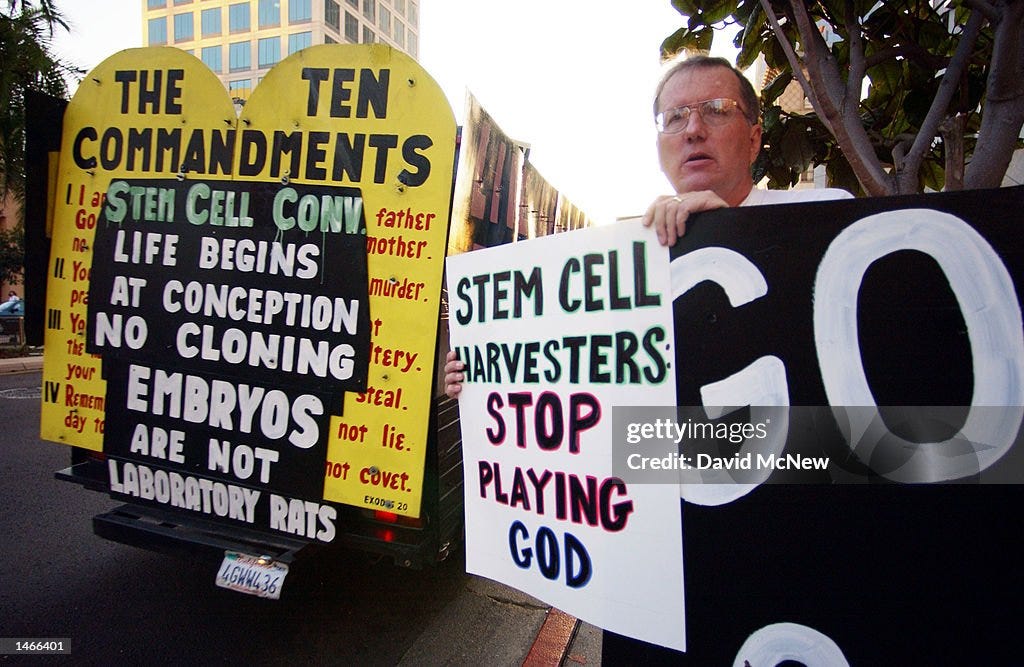
August 2001. George W. Bush blocks federal funding for new embryonic stem cell research lines in the US.
In August 2001, George W. Bush blocked federal funding for research on new embryonic stem cell lines. For many of the policy’s supporters, the question underneath was when a soul begins. The embryos in question were blastocysts: microscopic clusters of cells, smaller than the tip of a needle, with no nervous system, no pain receptors, and no consciousness in any sense philosophy can defend.
The restriction lasted until March 2009, about seven and a half years, in the country with the best biomedical research infrastructure on Earth, in a field that held out hope for Parkinson’s, Alzheimer’s, type 1 diabetes, and spinal cord injury. Privately funded research could continue, but federal money was limited to cell lines that already existed. Parkinson’s alone affects almost twelve million people worldwide, and by my rough reckoning each year of delay in finding a disease-modifying treatment costs hundreds of thousands of quality-adjusted life years.
That number is rough and full of assumptions. We don’t know that full funding would have produced faster breakthroughs, and the biggest stem cell advance of that decade, Shinya Yamanaka’s induced pluripotent stem cells in 2006, came from Japan and sidestepped embryos altogether, which cuts against my argument a little. But the direction is hard to ignore: a value that couldn’t be weighed against anything ended up weighed against people who already existed, and nobody had to look at the bill.
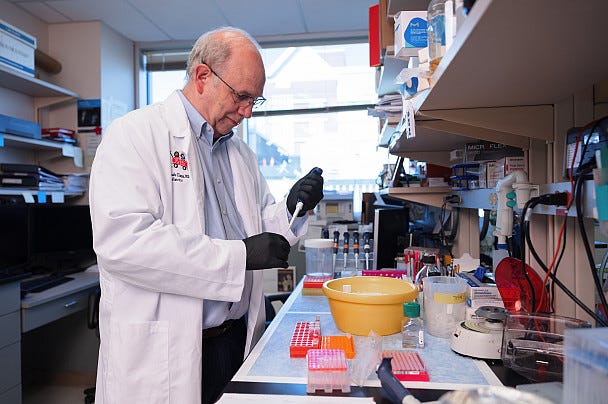
Dr. D. Wade Clapp’s work with British biotech company Healx dates to 2019. Photo by Liz Kaye, Indiana University. He uses AI to accelerate his research on tumour treatment.
IV.
The same bug in secular code
It would be convenient to stop here and conclude that the problem is religion. I don’t think that holds. What I’ve been describing is sacralization, a community taking something divisible and putting it beyond trade-offs, and religion is the oldest and most powerful technology for doing it. It’s far from the only one.
Consider organs. Selling a kidney is illegal almost everywhere, and a large part of the reason is that people find the idea repugnant, which is the phrase Alvin Roth, who shared the 2012 Nobel for market design, used for this whole class of constraint (Roth, 2007). There are real arguments about coercion and exploitation here, and I don’t think they’re settled. But much of the opposition has the shape of a taboo trade-off, in which even asking what a regulated, compensated system would cost and save gets treated as indecent. Meanwhile thousands of people die every year on transplant waiting lists in the United States alone.
Consider Germany’s exit from nuclear power, which for much of its political coalition was a matter of identity more than a line item. Stephen Jarvis, Olivier Deschenes, and Akshaya Jha estimated that the shutdowns after Fukushima cost roughly 3 to 8 billion euros a year in social cost, most of it from extra deaths caused by air pollution from the coal plants that filled the gap (Jarvis, Deschenes & Jha, 2022). You can dispute the estimate. What’s hard to dispute is that the trade-off was rarely allowed onto the table in those terms.
Or consider the most thoroughly secular state project of the twentieth century. Soviet Marxism-Leninism called itself scientific, and it still sacralized its own doctrine. In 1948 Trofim Lysenko’s pseudo-genetics became official, geneticists who disagreed lost their jobs or worse (Nikolai Vavilov, the country’s best plant geneticist, had already died in prison in 1943), and Soviet biology lost most of a generation. The ideology had no God in it and behaved exactly like the thing it claimed to have replaced.
This is why “replace religion with secular institutions” is too easy an answer, including the version of it I would have given a few years ago. Constitutions, human rights, international law, and the scientific method all have update mechanisms on paper: amendments, appeals, replication. But the people inside them can still sacralize a position, and when they do, the update mechanism stops working in exactly the same way. Watch some political movements operate and you’ll find heretics and excommunication with no theology involved.
So the useful line doesn’t run between religious and secular systems. It runs between systems that can admit they were wrong and systems that can’t, and religions differ on that too. Traditions of interpretation, from ijtihad to the dissenting opinions the Talmud records next to the majority ones, are update mechanisms. I suspect the communities that keep them alive find it easier to live alongside a modern state, though I can’t show that with data.
V.
What follows
If sacred values are the problem, the Ginges and Atran result suggests something about the fix. You can’t buy a sacred value out, since money makes it worse. What moves it is the currency it’s denominated in: recognition, respect, symbolic concessions that cost little and mean a lot. A negotiator who understands that will offer an apology before an aid package, and one who doesn’t will keep raising the cash and wondering why the room gets angrier.
For the rest of us, the discipline is smaller. Notice when you’re treating something as beyond trade-offs, and ask whether it’s physically divisible. Some things should stay sacred; I’d rather live in a society that won’t put a price on torturing a child. But when the sacred thing is a piece of land, a budget line, an energy source, or a lab protocol, refusing to weigh it doesn’t make the costs disappear. It moves them onto people who never get asked.
Go back to the behavioural economist from the beginning. If you had designed religion under those constraints, you’d be proud of it: it held together groups far larger than any primate brain could track, for thousands of years, with no police. You’d also know that the feature doing the work, a commitment nobody will renegotiate, is the same feature that makes compromise look like betrayal. That’s worth watching for in any system that asks for our loyalty, whether or not it has a God in it.