Like a Pump-and-Dump Stock
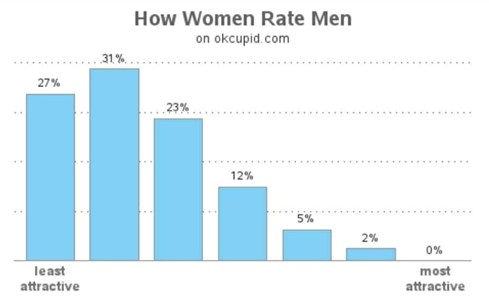
How Women Rate Men on okcupid.com
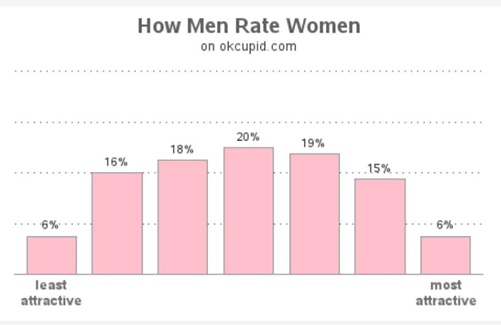
How Men Rate Women on okcupid.com
TL;DR
The Problem. The modern romance market is structurally broken. Not because of hypergamy. Hypergamy is a healthy, natural selection mechanism. The problem is that perceived market value on both sides has drifted far from intrinsic value, and no corrective mechanism is still working.
The Reasons. Four distortion vectors are running at once. (1) friendship echo chambers that don’t deliver corrective feedback. (2) cross-tier access from top-tier individuals that creates a misleading anchoring effect. (3) social media decoupling attention from actual value. (4) pornography setting the benchmark at the most extreme outlier. All four operate on both sides of the market. But the main reason the market doesn’t correct itself is that one group keeps absorbing all the consequences. Men who keep handing out attention, resources, and commitment with no reciprocity attached, and in doing so wipe out the negative feedback loop that ought to be recalibrating everyone’s expectations.
The Solution. Kafa’ah (sekufu). A mate-selection framework that has been Lindy for fourteen hundred years. The point isn’t to find the “best” or the “highest”. The point is to find the equal across four dimensions. Epistemology (how a person thinks and works through conflict), values (the basic moral compass), trajectory (energy and direction in life), and emotional capacity (willingness to do emotional work). Sekufu mechanically cuts every distortion vector because its target is calibration, not maximisation. Men who actually apply it stop being unconditional subsidisers as a side effect.
Epistemic Note. I was twenty when I wrote this, not long after the end of a relationship that was both exquisite and agonising. Discount accordingly for recency bias, negativity bias, and a sample size of one.
“In a market, price is set by the marginal buyer and the marginal seller. In the sexual marketplace, the marginal man has chosen to have no price at all.”
Friedrich August von Hayek or something, probably.
I.
The modern romance market is in a dysfunction that’s becoming increasingly well-documented. Marriage rates in industrialised countries are at historic lows. Birth rates have dropped below replacement. The share of the population that has never married or partnered keeps rising every decade. This is publicly available demographic data.
Who usually gets blamed? Dating app algorithms. Feminism. Capitalism. Pornography. Female hypergamy. All of these answers are partially true. All of them fundamentally miss the root.
Here is what I think is going on. The biggest reason price discovery in the romance market is broken is the collective behaviour of men who hand out subsidies with no conditions. Attention, resources, and commitment given without any meaningful reciprocity. In aggregate, this behaviour erases the negative feedback loop that ought to be correcting miscalibrated expectations on both sides.
Worth saying clearly what this essay is not claiming. It is not claiming that women are at fault for having standards. Hypergamy is an evolved mechanism, healthy and rational. It is not an incel manifesto or a blackpill rant. If anyone gets the blame here, it’s men. More precisely, the collective behaviour patterns of men that distort the market’s incentive structure.
II.
Hypergamy is the tendency to seek a partner with equal or higher status or genetic fitness. It is an evolved behavioural tendency with a solid biological foundation. Parental Investment Theory explains the mechanism. The sex that bears the heavier reproductive cost ends up evolutionarily more selective. In mammals, including humans, that’s the female. It isn’t a social construct. It’s an asymmetry that falls out of basic biology, and it’s been documented across cultures.
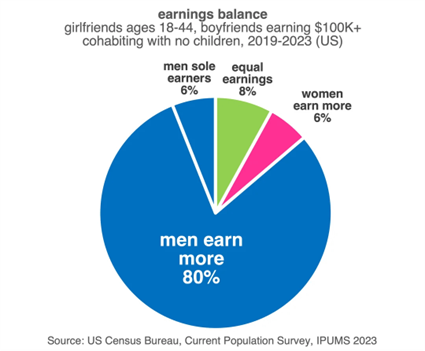
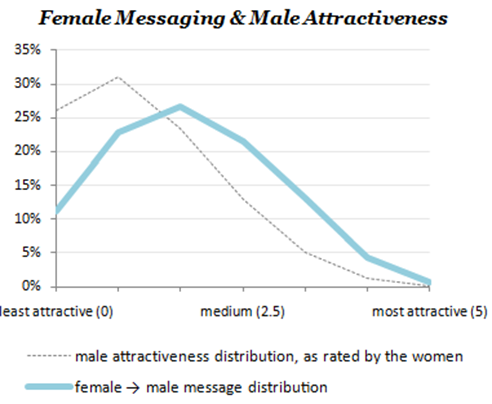
Bruch & Newman (2018) analysed 186,000 dating-platform users in the US and found that women, on aggregate, send messages to men who are on average 26% higher on the desirability hierarchy. (doi 10.1126/sciadv.aap9815)
Hitsch, Hortaçsu & Ariely (2010) analysed dating-platform data and found asymmetric preference distributions between men and women in how they evaluate attractiveness. (doi 10.1257/aer.100.1.130)
Under natural conditions, hypergamy is a healthy selection mechanism. A working selective system should produce pairings that are calibrated to reality. What’s broken is not the mechanism. What’s broken is the way several distortion vectors have made people’s perception of their own position in the hierarchy fundamentally miscalibrated, on both sides of the market.
III.
There are four main mechanisms that systematically distort perceived market value (fair value) and push it away from intrinsic value (overvalued). One important note before we start. These distortions operate bilaterally. They affect both men’s and women’s perceptions, though through different mechanisms and at different magnitudes.
Vector 1. Echo Chamber and the Absence of Corrective Feedback
- Taylor et al. (2000) identified the tend-and-befriend response as the stress response that’s more dominant in women. It evolutionarily encourages forming social alliances through mutual support and positive affect maintenance. Research shows that female friendships prioritise emotional validation over corrective honesty. (doi 10.1037/0033-295X.107.3.411)
Consequence in a dating context. Someone whose attractiveness is below the distribution mean, but who lives inside a social circle that constantly validates without correcting, will hold a miscalibrated self-assessment that the social ecosystem never repairs.
Vector 2. Cross-Tier Access and the Anchoring Effect
Men at the top percentiles for attractiveness, confidence, social dominance, and financial capability do not restrict their access by tier. From the same Bruch & Newman paper, the top decile of men receives a disproportionate share of match volume and conversation initiations from women across the full attractiveness range.
This produces an Anchoring Effect (Tversky & Kahneman, 1974). The first value or experience you encounter disproportionately influences every later evaluation. Someone who has been with a top-percentile individual even once, even casually, now holds an experiential benchmark that is not representative. Every prospective partner sitting at the normal-distribution mean will feel like a downgrade. Not because those people are bad in absolute terms, but because they’re being compared against an anchor that is an outlier.
Vector 3. Social Media and the Decoupling of Attention from Value
Before social media, the volume of attention someone received roughly reflected their position in the local social hierarchy. Social media has demolished that causal link.
Someone with average attractiveness who posts content on TikTok can receive hundreds of likes and dozens of messages from strangers within hours. That volume of attention, in the pre-digital era, would only have been received by someone objectively extraordinary. Say Marilyn Monroe or Alain Delon.
Vogel et al. (2014) found that exposure to social media featuring attractive people increases social comparison and significantly affects self-perception, even without direct interaction. (doi 10.1037/ppm0000047)
Halpern et al. (2016) found that Instagram use correlates positively with higher self-perceived social status, independent of objective attractiveness, especially when engagement is high. (doi 10.1089/cyber.2014.0560)
The result is an attention economy fully decoupled from underlying value. Someone who receives a thousand likes hasn’t become any more attractive empirically. But their perception of their market value shifts as if they had just been confirmed as “exceptional”. Apparently, no, they haven’t.
Vector 4. Pornography and the Distortion of Expectation
Mainstream pornography consistently features individuals who are extreme outliers in physical and performance distribution. It’s a representation-versus-actual-distribution problem.
- Wright et al. (2016) found, in a meta-analysis of 22 studies, that pornography consumption correlates with increased sexual-script internalisation, including expectations about physical appearance and duration of performance. (doi 10.1111/jcom.12201)
All four distortion vectors (echo chamber, cross-tier anchoring, social-media attention inflation, and pornography) move in the same direction. They push perceived market value away from intrinsic value, on both sides of the market.
IV.
In a healthy market, behaviour that isn’t calibrated to reality runs into natural consequences. Unrealistic expectations, in a romance market that’s functioning normally, get a signal back. Nobody is willing to meet those expectations. That signal forces recalibration. The market corrects itself.
But that signal never arrives. For a few reasons.
There is always a group that absorbs the consequences. By absorbing them, that group simultaneously erases the negative feedback loop that should have been correcting the market. Hayek introduced the concept of price discovery, which requires conditions in which prices can fluctuate in response to real supply and demand. When the supply of male attention, validation, and commitment never falls, regardless of conditions, price discovery cannot happen.
A few specific behaviour patterns contribute to this distortion.
The Permanent Standby
A man who waits on someone who has explicitly not chosen him as a priority. His presence as an always-available option sends a false signal about the other person’s market value, without proportionate effort from her. E.g. friendzoned.
The Unconditional Pardoner
A man who forgives boundary-crossing violations without demanding meaningful structural change. Every time a relational violation has no consequence, the market gets the signal that the behaviour is sustainable. E.g. staying after infidelity.
The Unconditional Subsidizer
A man who provides emotional support, financial resources, and consistent attention to someone who isn’t his partner and has no intention of becoming his partner. This is an unconditional subsidy, a transfer payment to a counterparty who delivers no return, and the subsidy artificially inflates the recipient’s perceived market value. E.g. fan behaviour.
The Desperate Settler
A man who accepts a relationship objectively below standard. Breadcrumbing, situationship without clarity, perpetual conditional commitment. He does it because he’s afraid of being alone. Every act of settling confirms to the market that low standards still produce committed partners. E.g. “beta” male.
In aggregate, these patterns build an ecosystem in which men collectively offer attention, resources, and commitment without any qualifying requirement at all, distorting the entire incentive structure of the market.

Expectation inflation does not happen because the ceiling is organically rising. It happens because the floor is being continuously lowered by men willing to accept any condition, and the absence of consequence wipes out the market’s corrective mechanism.
V.
None of these distortion vectors and unconditional subsidy patterns operate independently. They form a self-reinforcing feedback loop that amplifies itself every iteration.
Top-tier individuals interact cross-tier. An experiential reference point that isn’t representative gets created.
Friendship echo chambers don’t deliver corrective feedback. Miscalibrated self-assessment stays uncorrected.
Social media amplifies the illusion with attention inflation decoupled from intrinsic value.
Pornography sets a physical and performance benchmark from the extreme outlier of the distribution.
Both sides of the market enter with expectations systematically above their real intrinsic position.
The subsidiser group absorbs all the consequences, erasing the negative feedback that ought to have corrected things.
The loop iterates. Every cycle pushes expectations further from reality.
The result is a market structurally cut off from reality. Not because one gender is evil or irrational. Because the incentive structure is distorted by aggregate behaviour, and no corrective mechanism is operating effectively.
VI.
What Is Sekufu
In the Islamic legal tradition, kafa’ah (or sekufu in Indonesian) is the principle that an ideal partner is one who is equal. Not identical, but matched in the dimensions that materially predict long-term success.
Classical fiqh names a few dimensions of kafa’ah. Nasab (lineage), din (religious practice), hurriyyah (freedom), hirfah (profession), and mal (wealth). The theological details vary across schools. But the underlying operational principle, that equality in fundamental dimensions is a prerequisite for relationship success, is what’s Lindy.
The Dimensions of Sekufu
A. Epistemic Sekufu, or Equality in How You Think
This is the most important dimension and the one most often ignored. It isn’t about identical IQ. It’s about how a person processes information, handles disagreement, and revises beliefs.
The diagnostic question. Can he argue without attacking character? Can he change his mind when presented with new evidence? Is he interested in ideas, or only in conclusions that confirm what he already believes?
Gottman called these “masters of relationship”. They aren’t couples who never fight. They are couples who fight productively. The capacity to fight productively correlates strongly with epistemic equality. Two people who can treat conflict as a shared problem-solving exercise rather than a zero-sum war.
Epistemic incompatibility creates frustration that cannot be resolved. If you approach conflict with logic and data while your partner approaches it with emotional manipulation, no repair mechanism is going to work. You’re operating on communication protocols that are fundamentally incompatible.
B. Values Sekufu, or Equality in the Moral Compass
Not equality of opinion. Opinions are allowed to differ substantially. What has to match is fundamental values. How you see honesty, loyalty, ambition, responsibility, and fairness.
Per Gottman, fundamental differences in values (not preferences, but values) are one of the strongest predictors of relationship failure that can’t be repaired.
The practical test. Picture the two of you facing a genuinely hard ethical dilemma. Not an abstract trolley problem, but a real situation. A friend of yours does something wrong, say infidelity. Do you confront him or stay quiet? Someone in your community is treated unjustly. Do you speak up or self-preserve? Does your moral compass point in roughly the same direction, even if you arrived through different reasoning?
C. Trajectory Sekufu, or Equality in Energy and Direction
This is closest to the classical kafa’ah concept of hirfah (profession) and mal (wealth). Status doesn’t have to match. Energy and life direction do.
Two people can have very different incomes but still be matched in ambition, work ethic, and direction. The reverse also holds. Two people with identical incomes can be fundamentally unmatched if one is driven and the other is complacent. What the research on relationship satisfaction predicts is not equal income. It’s equal perceived effort and direction. Whether both people feel that the other is working just as hard to build a shared life.
Trajectory incompatibility produces one of two destructive dynamics. Resentment from the one who feels she’s dragging the relationship, or inadequacy from the one who feels he’s falling behind. Both are toxic. Both are hard to fix.
D. Emotional Sekufu, or Equality in Regulation Capacity
Are you matched in your capacity to recognise, express, and regulate emotion?
If one person is used to introspection and managing emotion, while the other is still entirely reactive and has never consciously processed any emotional experience, the relationship will end up in an exhausting asymmetry. One person will become a de facto therapist. The other will be the perpetual patient. That isn’t really a partnership. It’s closer to caregiving.
This doesn’t mean both people have to be “healed”. Nobody is fully healed. There has to be a matched willingness to do the emotional work. A relationship cannot survive on one person managing both people’s emotional lives.
Sekufu as Anti-Distortion
Practised genuinely, the principle of sekufu mechanically cuts every distortion vector identified in Section III.
How does sekufu correct the echo chamber? Sekufu forces honest self-assessment because the target isn’t “the best I can get” but “the equal of who I really am”. That inherently requires honesty about your own position.
How does sekufu correct cross-tier anchoring? Sekufu explicitly rejects the outlier as a benchmark. The target is equality, not maximisation. The anchoring effect from outlier experience is eliminated.
How does sekufu correct social media attention inflation? Sekufu decouples self-worth from external validation, because the target is substantive fit, not a status hierarchy inflated by digital metrics.
How does sekufu correct pornography? Sekufu rejects extreme physical outliers as legitimate standards and refocuses evaluation on the dimensions that actually predict long-term relationship success.
How does sekufu correct unconditional subsidy? A man who applies sekufu naturally stops being a subsidiser, because he only invests time and energy in people who are genuinely matched, not in people whose self-assessed hierarchy is unrealistic.
Sekufu as Via Negativa
In practice, sekufu is more powerful as a negative filter than as a positive checklist. You aren’t looking for someone whose epistemology is identical to yours. You’re learning to recognise the markers of incompatibility.
Epistemic incompatibility. You feel constantly forced to simplify yourself, or constantly forced to prove yourself. Conflict always ends in personal attack instead of resolution.
Values incompatibility. The two of you keep returning to the same fundamental disagreement about what’s “right” and “wrong”. Not about opinion. About principle.
Trajectory incompatibility. You feel you’re always dragging or always falling behind. There’s a chronic resentment about who’s working harder.
Emotional incompatibility. You feel you’re always the therapist and never the partner. Or the reverse. You feel constantly “handled” instead of understood.
Sekufu is not about finding a mirror. Sekufu is about finding the person who, when you stand next to them, is standing on roughly the same elevation, even if the view each of you sees from there is different.
My old man once put it like this. Cari pasangan yang setara, kalau tidak setara, yang di atas susah gendongnya, yang di bawah terlalu berat manjatnya. Find an equal. Otherwise the one above is too hard to carry, and the one below is too heavy to climb.
VII.
For Men Who Recognise Themselves in Section IV
Stop the unconditional subsidy. Every bit of attention, resource, and emotional labour you give to someone who doesn’t reciprocate meaningfully is a direct contribution to market distortion. This isn’t about becoming cold. It’s about acknowledging that you have value, and that value requires reciprocity to be taken seriously.
Separate forgiveness from unconditional pardon. Forgiveness paired with accountability and behavioural change is a sign of strength. Forgiveness without conditions is a wrong price signal, not just for you, but for the ecosystem.
Invest in yourself as a principle, not as a dating tactic. Status, ambition, and self-sufficiency are consistently stable attractiveness factors. But make this a principle of life, not a tactic.
Apply sekufu actively. Only invest your relational time and energy in people who are genuinely matched in epistemology, values, trajectory, and emotional capacity. This isn’t about “raising standards”. It’s about calibrating standards to reality. Know honestly where your own level sits.
If you realise you are orbiting someone, you have two choices. Escalate with explicit communication, or exit. There is no third option that doesn’t distort the market.
For Everyone
Treat standards as bilateral. The standard you apply to a prospective partner has to be commensurate with the standard you apply to yourself. This is basic market logic. You can’t demand a high price if you haven’t invested in your own value. Have skin in the game.
Reduce algorithmic exposure to outliers. Cut down the time you spend on dating apps and social media as your main calibration source. There’s a strong correlation between heavy social media use and distorted perception of social and relational reality. It applies to every gender.
Calibrate expectations to the real distribution, not to the most visible outliers. The people you see on TikTok, Bumble, and Instagram are extreme outliers from a very large distribution. Availability heuristic, judging probability by how easy something is to imagine rather than by actual frequency, is a bias that operates universally.
Look for honest feedback, not only validation. Outcome-based self-assessment is more reliable than opinion-of-your-social-circle self-assessment. If your relationship pattern consistently ends the same way, that’s data. Listen to it.
Normalise honest conversation about all of this. One reason these distortions persist is that nobody wants to talk about them openly. Men are afraid of being called bitter. Women are afraid of being called shallow. As a result, everyone operates on a set of beliefs that never gets challenged.
For Top-Tier Individuals
Be honest about intentions up front. Casual interactions that aren’t clearly communicated create misleading experiential data on the other side. This isn’t about avoiding casual relationships. It’s about transparency that reduces miscalibration.
Use your social capital for healthier norms. People imitate the behaviour of those they perceive as high status. If you normalise boundaries, reciprocity, and honest communication, the effect carries beyond you.
VIII.
This essay doesn’t blame one gender. Hypergamy is an evolved mechanism, healthy and rational. High standards are an individual right. What’s identified here is something more specific. The distortion in the romance market is mainly not caused by hypergamy itself, but by the way a set of feedback loops has separated perceived value from intrinsic value, amplified critically by collective behaviour that gives unconditional subsidies.
The most Lindy solution, the one that has held up for over fourteen centuries, is an old principle that is simple but demanding. Find the one who is sekufu. Not the most attractive. Not the most status. The equal in how you think, in your values, in your direction in life, and in your willingness to do emotional work.
Recalibration isn’t going to feel comfortable. Every correction to inflated expectations will feel like settling, but only because the baseline is already distorted. What’s actually happening is returning to reality. And reality, less interesting than the fiction generated by your echo chamber, your social media, and your pornography, is the only place where a relationship that genuinely lasts can be built.
Accept that recalibration doesn’t feel good. But don’t blame the market. Be part of the correction.