Like a Deep-Fried Stock
Epistemic status: I was twenty when I wrote this, not long after the end of a relationship that was both exquisite and agonizing. Discount for recency bias, negativity bias, and a sample size of one. I flag the weakest parts of the evidence as I go.
The short version: the modern romance market is broken by miscalibration. Perceived value on both sides has drifted far from intrinsic value, pushed up by four distortions (friendship echo chambers, cross-tier anchoring, social media, and pornography), and the feedback that should pull it back gets absorbed by men who hand out attention, resources, and commitment with no reciprocity attached. Hypergamy, which usually gets the blame, is a healthy mechanism. The fix I propose is kafa’ah (sekufu), a mate-selection principle that has been Lindy for fourteen hundred years: match with an equal in how you think, what you value, where you’re going, and how you handle emotion.
“In a market, price is set by the marginal buyer and the marginal seller. In the sexual marketplace, the marginal man has chosen to have no price at all.”
Friedrich August von Hayek or something, probably.
I.
In Indonesian market slang, a stock that a coordinated group of traders (a bandar) has pumped until its price has nothing to do with the company behind it is called a saham gorengan, a deep-fried stock. The frying works for a while. The chart goes up, retail investors pile in because the chart is going up, and the rising price starts to serve as its own evidence. Analysts can point out that it’s overvalued as often as they like; anyone who cared about fundamentals knew that already. The price comes down when the buying at any price stops, and the people still holding the stock find out what it was worth all along.
I think a good part of the modern romance market trades like that, and this essay is my attempt to explain why.
The symptoms are well documented. Marriage rates in industrialized countries are at historic lows, birth rates have dropped below replacement, and the share of the population that has never married or partnered keeps rising every decade. All of this is public demographic data.
The usual suspects are dating-app algorithms, feminism, capitalism, pornography, and female hypergamy. Each of them explains part of the picture, and I think all of them miss the part that keeps the picture from correcting itself.
Here’s what I think is going on. Price discovery in the romance market is broken mainly because of the collective behaviour of men who hand out subsidies with no conditions attached: attention, resources, and commitment given without any meaningful reciprocity. In aggregate, this behaviour erases the negative feedback loop that ought to correct miscalibrated expectations on both sides. In the stock analogy, these men are the buyers who keep buying at any price. They keep the chart going up, and they’re usually the ones left holding the bag.
I want to be clear about scope before going further. Women are entitled to their standards; hypergamy is an evolved mechanism, and a healthy, rational one, and this essay isn’t meant as an incel manifesto or a blackpill rant. If anyone gets the blame here, it’s men, or more precisely the collective behaviour patterns of men that distort the market’s incentive structure.
II.
Hypergamy is the tendency to seek a partner of equal or higher status or genetic fitness. It’s an evolved behavioural tendency with a solid biological foundation, and Parental Investment Theory (Trivers, 1972) explains the mechanism: the sex that bears the heavier reproductive cost evolves to be more selective. In mammals, humans included, that’s the female. The asymmetry falls out of basic biology, and it has been documented across cultures; David Buss’s 1989 study of mate preferences in 37 cultures is the classic reference.
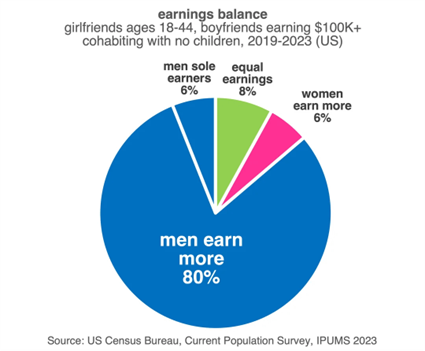
The chart above (US Census data on childless cohabiting couples where the man earns $100K or more) shows him out-earning her in 86% of cases. Picking couples by the man’s income mechanically favours that result, so it’s weak evidence. The dating-platform research is better:
Bruch & Newman (2018), analyzing about 187,000 users of a US dating site, found that people message partners about 25% more desirable than themselves (26% for men, 23% for women). That’s aspiration on both sides more than hypergamy specifically, but the aspiration gap is the raw material for the miscalibration I describe below. (doi 10.1126/sciadv.aap9815)
Hitsch, Hortaçsu & Ariely (2010) estimated mate preferences from online-dating data. The weight people put on looks barely differed by sex, but women put about twice as much weight on a partner’s income as men did, and showed a strong preference for tall and educated partners. (doi 10.1257/aer.100.1.130)
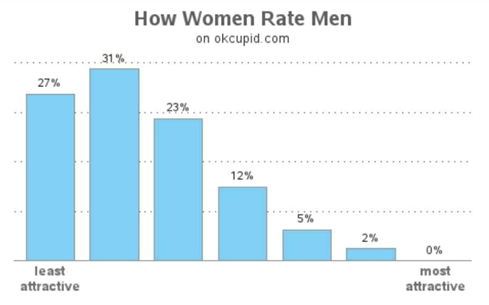
How Women Rate Men on okcupid.com
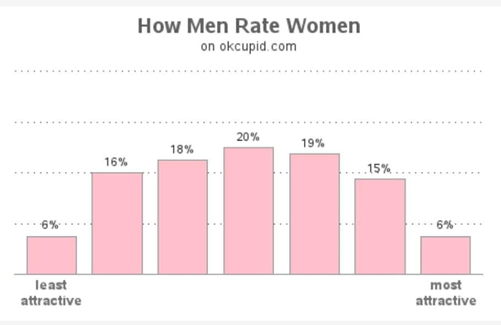
How Men Rate Women on okcupid.com
The two charts above are an older, cruder version of the same kind of data. In 2009, OkCupid’s data blog reported that women on the site rated about 80% of men as worse-looking than medium, while men’s ratings of women formed a symmetric curve (Christian Rudder, “Your Looks and Your Inbox”). The same post has a detail that’s awkward for anyone who wants to blame women: women’s messages aimed only slightly above the curve, while two-thirds of men’s messages went to the best-looking third of women. I’ll come back to that, because I think it’s the subsidy problem in miniature.
Under natural conditions, hypergamy is a healthy selection mechanism, and a working selective system should produce pairings that are calibrated to reality. The trouble is that several distortions have left people miscalibrated about their own position in the hierarchy, on both sides of the market.
III.
I see four main mechanisms that systematically push perceived market value above intrinsic value, the way frying pushes a stock above its fundamentals. They work on both sides of the market, affecting men’s and women’s perceptions alike, through different mechanisms and at different magnitudes.
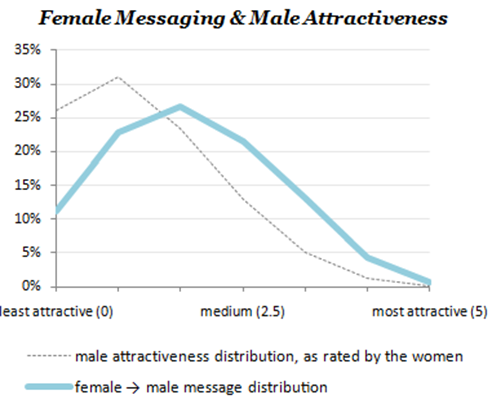
The chart above is the messaging half of the same OkCupid data: women wrote to men a little above where they rated them (the solid line against the dotted one), which is roughly what healthy hypergamy looks like. The four vectors below are forces that push that solid line to the right.
Vector 1. Echo chambers and the absence of corrective feedback
Taylor et al. (2000) described the “tend-and-befriend” stress response, which is more dominant in women: under stress, it pushes toward forming social alliances through mutual support and keeping the emotional tone positive (doi 10.1037/0033-295X.107.3.411). My extrapolation, and it’s mine rather than theirs, is that friendships built around that response tend to prioritize emotional validation over corrective honesty.
In a dating context, the consequence looks like this. Someone whose attractiveness sits below the mean of the distribution, but who lives inside a social circle that constantly validates and never corrects, will hold a miscalibrated self-assessment that the social ecosystem never repairs.
Vector 2. Cross-tier access and the anchoring effect
Men in the top percentiles for attractiveness, confidence, social dominance, and financial capability don’t restrict themselves to their own tier, and on dating apps they don’t have to. Attention on these platforms is steeply unequal: in Bruch & Newman’s data, the number of messages people receive has a long tail for both sexes, with most people getting a handful at most and a small fraction getting far more. I don’t have good data on how often that attention turns into cross-tier relationships, so treat this vector as an argument from mechanism.
The mechanism is anchoring, in the sense of Tversky and Kahneman (1974), extended from numbers to experiences: the first value you encounter has a disproportionate influence on every later evaluation. Someone who has been with a top-percentile partner even once, even casually, now holds an experiential benchmark that isn’t representative, and every prospective partner near the middle of the distribution feels like a downgrade. Those people aren’t bad in absolute terms; they’re being compared against an anchor that happens to be an outlier.
Vector 3. Social media and the decoupling of attention from value
Before social media, the amount of attention someone received roughly reflected their position in the local social hierarchy. Social media has cut that link.
Someone of average attractiveness who posts on TikTok can get hundreds of likes and dozens of messages from strangers within hours. In the pre-digital era, that volume of attention went only to someone objectively extraordinary, your Marilyn Monroe or Alain Delon.
The result is an attention economy decoupled from underlying value. Someone who gets a thousand likes hasn’t become any more attractive, but their sense of their own market value can shift as if they’d just been confirmed as exceptional, which they haven’t.
I should admit that the evidence here is messier than I’d like, and most of it points the other way. Vogel et al. (2014) found that heavier Facebook users had lower self-esteem, largely through upward comparison, and that viewing a stranger’s more impressive profile lowered self-esteem on the spot (doi 10.1037/ppm0000047). Lup, Trub & Rosenthal (2015) found that among Instagram users who follow many strangers, more use goes with more negative social comparison and more depressive symptoms (doi 10.1089/cyber.2014.0560). Both findings are deflation rather than inflation. My guess is that both effects are real and hit different people: inflation for those who receive a lot of attention, deflation for those who mostly watch. Only the second half has experiments behind it, so I hold the first half loosely.
Vector 4. Pornography and the distortion of expectation
Mainstream pornography consistently features people who are extreme outliers in the physical and performance distributions, which makes it a textbook representation-versus-reality problem: viewers calibrate against the tail and then meet the middle.
I’m confident about that mechanism and much less confident about its size. The best-known meta-analysis in this area, Wright, Tokunaga & Kraus (2016), covers pornography and sexual aggression (doi 10.1111/jcom.12201), and I haven’t found anything equally solid on expectations about appearance and performance. Treat this vector as the most speculative of the four.
Three of the four (echo chambers, cross-tier anchoring, and pornography) push expectations up fairly reliably, and social media pushes them up for some people and down for others. What they have in common is that they move perceived market value away from intrinsic value, on both sides of the market.
IV.
In a healthy market, behaviour that isn’t calibrated to reality runs into natural consequences. In a romance market that’s functioning normally, unrealistic expectations get a signal back, namely that nobody is willing to meet them, and that signal forces recalibration. The market corrects itself.
That signal never arrives, for a few reasons.
There’s always a group that absorbs the consequences, and by absorbing them it erases the negative feedback loop that should have corrected the market. Hayek’s point in “The Use of Knowledge in Society” was that prices carry information, and they can only do that when they’re free to move with real supply and demand. When the supply of male attention, validation, and commitment never falls, whatever the conditions, price discovery can’t happen.
Remember the OkCupid finding that two-thirds of men’s messages went to the best-looking third of women. I think that’s the subsidy problem at its smallest scale. Each of those messages cost its sender almost nothing, and a flood of cheap signals tells the person receiving it that demand is deeper than it is. The patterns below are the same thing with more at stake.
The Permanent Standby
He’s the man who keeps waiting on someone who has explicitly not made him a priority. His presence as an always-available option sends a false signal about her market value, at no proportionate cost to her. The friend zone is the classic case.
The Unconditional Pardoner
He forgives boundary-crossing violations without asking for any meaningful structural change. Every time a violation in a relationship carries no consequence, the market learns that the behaviour is sustainable. Staying after infidelity with nothing changed is the classic case.
The Unconditional Subsidizer
He provides emotional support, financial resources, and consistent attention to someone who isn’t his partner and has no intention of becoming his partner. That’s an unconditional subsidy, a transfer payment to a counterparty who delivers nothing in return, and it artificially inflates the recipient’s perceived market value. Fan behaviour is the classic case.
The Desperate Settler
He accepts a relationship objectively below standard (breadcrumbing, an unclear situationship, perpetually conditional commitment) because he’s afraid of being alone. Every act of settling tells the market that low standards still produce committed partners. The self-described “beta” male is the classic case.
In aggregate, these patterns build an ecosystem in which men collectively offer attention, resources, and commitment without any qualifying requirement at all, which distorts the incentive structure of the whole market.

Expectations inflate from the bottom: the floor keeps being lowered by men who will accept any condition, the missing consequences wipe out the market’s corrective mechanism, and nothing organic is raising the ceiling.
V.
None of these distortions and subsidy patterns operates on its own. Together they form a feedback loop that amplifies itself with every iteration:
Top-tier individuals interact across tiers, which creates reference points that aren’t representative.
Friendship echo chambers don’t deliver corrective feedback, so miscalibrated self-assessments stay uncorrected.
Social media adds attention that has come loose from intrinsic value.
Pornography sets physical and performance benchmarks at the extreme tail of the distribution.
Both sides of the market enter with expectations systematically above their real position.
The subsidizers absorb the consequences, erasing the negative feedback that should have corrected things.
The loop repeats, and each pass pushes expectations further from reality.
The result is a market structurally cut off from reality. Neither gender has to be evil or irrational for this to happen; aggregate behaviour has distorted the incentive structure, and no corrective mechanism is working well enough to fix it.
VI.
Before I get to what I think fixes this, here are the three objections I take most seriously.
The first is that the decline in marriage is an economic story and needs no theory of subsidies. William Julius Wilson argued in the 1980s that when men’s jobs and earnings collapse, fewer of them look like viable husbands, and Autor, Dorn & Hanson (2019) found exactly that: where manufacturing competition hit young American men’s earnings relative to young women’s, marriage and fertility fell (doi 10.1257/aeri.20180010). I think this explains a real share of the trend, and I don’t know how to split the blame. But the two stories answer different questions. The economic one explains why fewer men clear the bar; mine is about a force that slows the bar’s adjustment when they don’t.
The second is that I’m calling love a market distortion. Plenty of traditions praise giving without expecting anything back, and teaching men to withhold kindness until it’s reciprocated sounds like a recipe for colder people. My answer is that two things hide under “unconditional”. Unconditional commitment inside a relationship, where both people have made promises and both carry the downside, is what marriage vows are for. What I’m criticizing is one-sided investment in someone who has declined the relationship. Taleb would call the difference symmetry: skin in the game means both sides carry the downside. I’m least sure about the Unconditional Pardoner, since forgiving infidelity is sometimes the right call; what I’d defend is that forgiveness with no change in behaviour teaches both people that the behaviour is free.
The third is to the whole frame. “Sexual market value” is manosphere vocabulary (economists have written about marriage markets since Gary Becker, but that phrase comes from somewhere worse), and thinking of people as stocks might make you worse at loving any of them. I take this seriously. The market frame is good at explaining one thing, why expectations stay wrong when nothing pushes back on them, and much worse at everything else, and I’d rather you drop it than let it take over how you think about people.
What would change my mind is evidence that expectations adjust when the pool of partners changes, and some of that already exists. Esteve and colleagues (2016) found, across 120 countries, that as women overtook men in education, marriages in which the wife had more education than the husband became steadily more common (doi 10.1111/padr.12012). On education, at least, the market adjusted, which counts against the strong version of my claim. My best reply is that education is a credential anyone can check, while the distortions I’ve described act on things that are much harder to measure, like attractiveness and desirability. That reply is testable, and I’d like to see it tested.
VII.
What sekufu is
In the Islamic legal tradition, kafa’ah (sekufu in Indonesian) is the principle that the ideal partner is an equal: someone matched with you, which is different from identical, in the dimensions that materially predict long-term success.
Classical fiqh names several dimensions of kafa’ah: nasab (lineage), din (religious practice), hurriyyah (freedom), hirfah (profession), and mal (wealth). The theological details vary across schools, but the underlying operational principle, that equality in fundamental dimensions is a prerequisite for a relationship to succeed, is the part that’s Lindy.
The dimensions of sekufu
A. Epistemic sekufu: equality in how you think
This is the most important dimension and the one most often ignored. It’s about how a person processes information, handles disagreement, and revises beliefs.
The diagnostic questions: can he argue without attacking your character? Can he change his mind when you show him new evidence? Is he interested in ideas, or only in conclusions that confirm what he already believes?
John Gottman’s research on couples is useful here. The couples he calls the masters of relationships fight too; the difference is that they fight productively, and I think the capacity to fight productively is closely tied to epistemic equality. It means two people can treat a conflict as a shared problem to solve rather than a zero-sum war.
Epistemic incompatibility creates frustration that can’t be resolved, because the two of you are running communication protocols that are fundamentally incompatible, and no repair mechanism works across that gap.
B. Values sekufu: equality in the moral compass
Opinions can differ a lot. What has to match is fundamental values: how each of you sees honesty, loyalty, ambition, responsibility, and fairness.
Gottman’s work is usually cited for a finding that surprises people: most couples’ conflicts are never resolved, and what predicts failure is how couples fight (contempt, above all) more than what they fight about. I’d still put values here, because the conflicts that harden into permanent gridlock tend to be about deep values and life dreams.
The practical test: picture the two of you facing a hard ethical dilemma, a real situation and nothing as abstract as a trolley problem. A friend of yours does something wrong, say he cheats on his partner. Do you confront him or stay quiet? Someone in your community is treated unjustly. Do you speak up or protect yourself? Does your moral compass point in roughly the same direction as your partner’s, even if the two of you got there by different reasoning?
C. Trajectory sekufu: equality in energy and direction
This is the dimension closest to the classical categories of hirfah (profession) and mal (wealth). Status doesn’t have to match; energy and life direction do.
Two people can have very different incomes and still be matched in ambition, work ethic, and direction, and the reverse holds too: two people with identical incomes can be badly unmatched if one is driven and the other is complacent. As far as I can tell from the research on relationship satisfaction, what matters is perceived equality of effort and direction, more than equal income: whether each person feels the other is working just as hard to build a shared life.
Trajectory incompatibility produces one of two destructive dynamics: resentment in the partner who feels she’s dragging the relationship, or inadequacy in the partner who feels he’s falling behind. Both are toxic and hard to fix.
D. Emotional sekufu: equality in regulation capacity
Are the two of you matched in your capacity to recognize, express, and regulate emotion?
If one person is used to introspection and managing emotion while the other is entirely reactive and has never consciously processed an emotional experience, the relationship ends up in an exhausting asymmetry. One person becomes the de facto therapist and the other the perpetual patient, and at that point it’s closer to caregiving than to a partnership.
This doesn’t mean both people have to be healed; nobody is fully healed. What has to match is the willingness to do the emotional work, because a relationship can’t survive on one person managing both people’s emotional lives.
Sekufu as anti-distortion
Practised properly, sekufu cuts through every distortion from Section III. It corrects the echo chamber because its target, “the equal of who I really am”, requires an honest self-assessment, where the echo chamber aims at “the best I can get”. It corrects cross-tier anchoring and the pornography benchmark because an outlier stops being a reference point once the target is equality. It corrects social-media inflation because it ties self-worth to substantive fit, which likes can’t inflate. And it ends unconditional subsidy almost by definition, since a man who applies it only invests time and energy in people who are actually matched with him.
Sekufu as via negativa
In practice, sekufu works better as a negative filter than as a positive checklist, which is Taleb’s via negativa applied to romance. Searching for someone whose epistemology is identical to yours is hopeless; learning to recognize the markers of incompatibility is much easier and more reliable. Here are the ones I’d watch for:
Epistemic incompatibility: you feel constantly forced to simplify yourself, or constantly forced to prove yourself, and conflict always ends in personal attack instead of resolution.
Values incompatibility: the two of you keep returning to the same fundamental disagreement about what’s right and wrong, on principle rather than on opinion.
Trajectory incompatibility: you feel you’re always dragging or always falling behind, and there’s a chronic resentment about who’s working harder.
Emotional incompatibility: you feel you’re always the therapist and never the partner, or the reverse, and you feel constantly “handled” instead of understood.
Sekufu means finding the person who, when you stand next to them, is standing at roughly the same elevation, even if each of you sees a different view from there. That’s a lot more interesting than finding a mirror.
My old man once put it like this: Cari pasangan yang setara, kalau tidak setara, yang di atas susah gendongnya, yang di bawah terlalu berat manjatnya. Find an equal. Otherwise the one above is too hard to carry, and the one below is too heavy to climb.
VIII.
For men who recognize themselves in Section IV
Stop the unconditional subsidy. Every bit of attention, resources, and emotional labour you give to someone who doesn’t reciprocate in any meaningful way contributes directly to the market distortion. You don’t have to become cold; you do have to accept that you have value, and that value given away without reciprocity doesn’t get taken seriously.
Separate forgiveness from unconditional pardon. Forgiveness paired with accountability and changed behaviour is a sign of strength. Forgiveness with no conditions sends a wrong price signal, to the ecosystem as well as to you.
Invest in yourself as a principle of life. Status, ambition, and self-sufficiency are consistently stable attractiveness factors, but they work best when you pursue them for their own sake, and they curdle when they become a dating tactic.
Apply sekufu actively. Invest your relational time and energy only in people who are actually matched with you in epistemology, values, trajectory, and emotional capacity. The goal is standards calibrated to reality, which isn’t the same thing as raised standards, and that starts with an accurate read of where your own level sits.
If you realize you’re orbiting someone, you have two choices: escalate with explicit communication, or exit. Any third option distorts the market.
For everyone
Treat standards as bilateral. The standard you apply to a prospective partner has to match the standard you apply to yourself. That’s basic market logic: you can’t demand a high price without having invested in your own value. Have skin in the game.
Reduce your algorithmic exposure to outliers. Spend less time on dating apps and social media as your main source of calibration. The studies in Section III found heavy social-media use pushing people’s self-assessment down, and I’ve argued it can push the other way for people who receive a lot of attention. Either way it’s a bad instrument for calibration, whatever your gender.
Calibrate expectations to the real distribution, as opposed to the most visible outliers. The people you see on TikTok, Bumble, and Instagram are extreme outliers from a very large distribution, and the availability heuristic (judging probability by how easily something comes to mind rather than by how often it actually happens) is a bias everyone runs on.
Look for honest feedback, beyond validation. Outcome-based self-assessment is more reliable than your social circle’s opinion of you. If your relationships keep ending the same way, that’s data, and you should listen to it.
Normalize honest conversation about all of this. One reason these distortions persist is that nobody wants to talk about them openly: men are afraid of being called bitter, women are afraid of being called shallow, and as a result everyone runs on beliefs that never get challenged.
For top-tier individuals
Be honest about your intentions up front. Casual interactions that aren’t clearly communicated create misleading experiential data for the other person. You can still have casual relationships; what reduces miscalibration is transparency.
Use your social capital for healthier norms. People imitate the behaviour of those they see as high-status, so if you normalize boundaries, reciprocity, and honest communication, the effect spreads beyond you.
IX.
None of this makes women the villains of the story. Hypergamy is healthy and rational, and high standards are an individual right. The distortion comes from feedback loops that have separated perceived value from intrinsic value, amplified by men handing out unconditional subsidies.
The most Lindy fix I know, one that has held up for more than fourteen centuries, is an old principle that is simple and demanding: find the person who is sekufu with you. That means your equal in how you think, in your values, in your direction in life, and in your willingness to do emotional work, even if they aren’t the most attractive or highest-status option in sight.
Go back to the deep-fried stock for a moment. When the buying at any price finally stops, the price falls to what real people will pay for the real thing, and for everyone holding the stock, that moment feels like a loss. It’s also the first accurate price they’ve seen in a while.
I expect recalibration in the romance market to feel the same way. Every correction to an inflated expectation will feel like settling, because the baseline it’s measured against is already distorted. I think it’s worth it anyway, and the price only comes back to earth when enough of us stop buying at any price.