Smokers Are Cowards
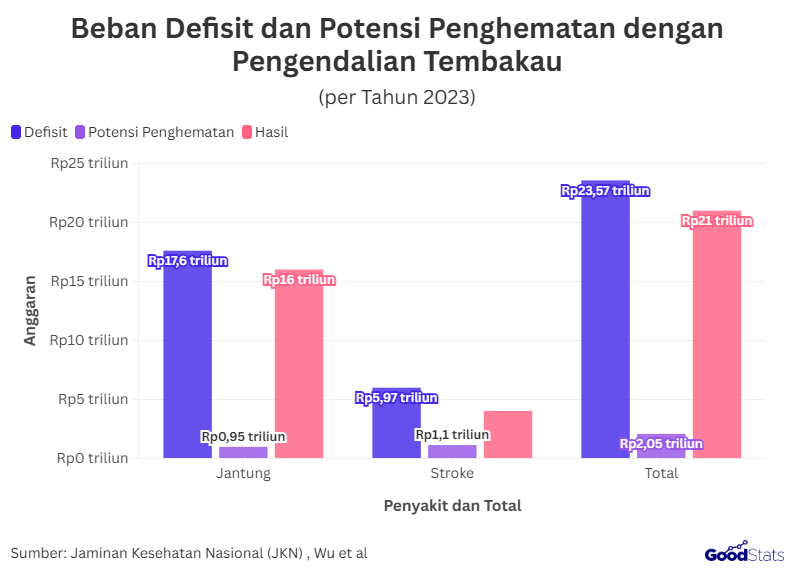
from JKN (2023)
Epistemic status: confident about the harms, less confident about the fiscal accounting, and deliberately provocative about the word “coward”, which I defend in Section IV. Figures are the latest I could find, with years given.
There’s a guy at the warung kopi next to me. He lights a kretek, takes a long drag, and blows the smoke toward the next table, where a young mother sits with her baby. The baby is maybe nine months old. Nobody at the warung thinks this is strange, and the mother doesn’t even flinch.
About seventy million Indonesian adults smoke. I’m going to argue that a lot of them, every time they light up next to someone who didn’t choose it, are being cowards, and I think that claim is worth a few thousand words.
I.
The standard defence is “it’s my right”. Let’s see if that holds.
Rights end where they start harming someone else. You have the right to swing your fist, and that right ends at the tip of someone else’s nose. Cigarette smoke doesn’t stop at a nose. The smoke you exhale goes into your wife’s lungs, your kid’s lungs, and the lungs of a stranger sitting next to you on the angkot.
In the 2019 Global Youth Tobacco Survey, 66.2% of Indonesian students aged 13 to 15 said they’d been exposed to secondhand smoke in enclosed public places, and 57.8% at home. Tobacco kills about 290,000 Indonesians a year, by the Global Burden of Disease estimates, and more than 52,000 of those deaths come from secondhand smoke: people who died of someone else’s cigarettes.
Fifty-two thousand a year is about 142 people a day. The Kanjuruhan stadium disaster in October 2022, when police fired tear gas into packed stands with the exit gates locked, killed 135. So picture Kanjuruhan happening every single day, all year, except that none of the victims made the choice that killed them.
When a smoker says “my right”, what he’s claiming is the right to put carcinogens into someone else’s lungs without their consent. I don’t think that’s a right. I think it’s slow-motion violence.
Economists would call this a negative externality, and it’s the cleanest one you’ll find in everyday life. Someone takes a small benefit for himself (the pleasure of the cigarette) and transfers a large cost to people who didn’t agree to anything (secondhand smoke, public health costs, sick children). He gets the pleasure, and everyone else gets the cancer.
II.
“But smokers already pay the excise tax.”
This is the second most common defence, and it deserves a careful answer, because it’s partly right.
In 2022, Indonesia’s tobacco excise brought in about Rp218.6 trillion. Officials and the tobacco industry love this number and like to present it as a massive contribution to the state.
Now look at the other side of the ledger. A study cited by the Ministry of Health put the macroeconomic losses from tobacco in 2017 at Rp431.8 trillion, nearly three times that year’s excise revenue of Rp147.7 trillion. An earlier estimate by Soewarta Kosen of the ministry’s research agency put 2015 losses at about Rp596.6 trillion, a little over four times the Rp139.5 trillion collected that year. That second figure includes the money smokers spent on cigarettes themselves (about Rp209 trillion), which I’m not sure I’d count as a loss, but take it out and the remainder is still nearly three times the excise.
I should be precise about what those numbers mean, though. They’re mostly lost productive years and private costs, and only part of them is state spending. So it isn’t true that the state spends two to four rupiah cleaning up for every rupiah of excise. What’s true is that the economy as a whole loses two to four rupiah for every rupiah the excise brings in.
The state’s share shows up in BPJS Kesehatan. In 2023, it spent about Rp34.7 trillion on eight catastrophic illnesses, and heart disease alone took Rp17.6 trillion across roughly 20 million cases. Smoking is one of the main causes of the three biggest items on that list (heart disease, cancer, and stroke). More recently, the BPJS fund ran a deficit of about Rp7.1 trillion.
The chart at the top is more modest than the rhetoric usually is. Using JKN data and an estimate by Wu and colleagues, it puts JKN’s 2023 spending on heart disease and stroke at about Rp23.6 trillion, and estimates that tobacco control could save about Rp2 trillion of that a year, under a tenth. I think that’s the right order of magnitude to keep in mind: the fiscal case against smoking is real, but it’s the weaker half of the argument.
The strongest version of the other side is uglier, and I should state it. In 2001, a report that Arthur D. Little prepared for Philip Morris calculated that smoking was a net gain to Czech public finances, partly because smokers die early and stop drawing on health care and pensions. After a public outcry, Philip Morris apologized, and one of its senior executives called the report “a terrible mistake”. In accounting terms the argument holds together. As a defence, it fails for three reasons: the 52,000 people killed by secondhand smoke don’t appear anywhere on the smoker’s side of the ledger, most Indonesian workers are informal and have no pension for an early death to “save”, and a policy argument that works only because people die sooner is one even Philip Morris wouldn’t defend.
Who pays the gap? Everyone in the BPJS pool pays, smokers included, but the non-smokers are paying for risks they didn’t choose to take. The smoker keeps the upside and shares out the downside, which is exactly what Taleb means by having no skin in the game. That’s one of the reasons “coward” fits.
III.
The saddest part of this involves children.
Indonesia has one of the highest rates of youth smoking in the world. By the health ministry’s count, 5.9 million children aged 10 to 18 were active smokers in 2023. Among boys aged 15 to 19, smoking rose from 13.7% in 1995 to 37.3% in 2013.
At home, 59.3% of Indonesian adults were exposed to secondhand smoke in 2021, down from 78.4% in 2011 but still well over half. Children spend most of their time at home, which means many of them are passive smokers from the day they’re born, and sometimes before. Studies using Indonesia’s Demographic and Health Survey have linked exposure to secondhand smoke during pregnancy to low birth weight, and exposure in infancy is tied to sudden infant death, acute respiratory illness, stunting, and worse cardiovascular health later in life.
So where is the agency of these children?
Quitting is neurologically hard, many smokers started young because of social pressure, and agency is complicated. I grant all of that. But the argument about agency runs in both directions. If you want sympathy for a smoker whose agency has been chemically eroded by addiction, you also have to account for the agency of a baby who has been inhaling his father’s smoke since day one, and that baby’s agency is zero.
A man who lights up in the living room in front of his kids has options. He can go outside. He can stop smoking in the room where his children sleep. He can protect the people who depend on him most. These are small, cheap choices, and refusing them is where “coward” starts to sound about right.
IV.
I’m using the word “coward” on purpose, and I want to defend the choice.
Indonesia has a strong cultural link between smoking and masculinity. Cigarettes mark adulthood, camaraderie, being a real man. The advertising that sells this image, still legal here in forms that most of the region has banned, makes the association on purpose: the branding consistently sells adventure, courage, and freedom.
The reality of addiction is the opposite of that. A man who can’t sit through a thirty-minute meeting without fidgeting for a cigarette isn’t free; he’s working for a chemical. Someone who spends Rp50,000 a day on cigarettes (Rp1.5 million a month, Rp18 million a year) while his family lives below the poverty line isn’t being manly. The national data isn’t flattering either. In Statistics Indonesia’s household surveys, cigarettes are the second-largest item of food spending after prepared food and drinks, and the second-largest contributor to the poverty line after rice.
There’s a small piece of evidence I find suggestive. A survey of Mensa Indonesia members found that 10.8% of them smoked, against roughly a third of Indonesian adults. Only 102 of the society’s 408 members answered, so self-selection could explain a lot of it, and I wouldn’t lean on it much. But it points the same way as the broader pattern: the people best equipped to evaluate long-term risk seem to smoke less.
My complaint is about nerve rather than intelligence. The decision to keep smoking, in an era when the harms are documented everywhere, is driven by an inability to sit through the short-term discomfort of stopping, and it gets dressed up afterwards as strength, choice, or courage.
The standard justifications (“my grandpa smoked until he was ninety”, “we’re all going to die anyway”, “you only live once”) are survivorship bias dressed up as wisdom. A good rationalist would recognize them as motivated reasoning: finding reasons to defend a decision you’ve already made, instead of looking at the evidence before you make it.
That’s the kind of cowardice I mean. It’s less a lack of physical or even moral strength than an unwillingness to look straight at your own evidence.
V.
It would be unfair, and intellectually lazy, to attack only individuals and leave the system alone.
Indonesia fails to protect its citizens from tobacco, and in several ways it actively helps the industry. It’s the only country in Asia that has neither signed nor ratified the WHO Framework Convention on Tobacco Control. In SEATCA’s 2023 scorecard of tobacco control across ASEAN, Indonesia came last with 20.2 out of 100, against 77.2 for Thailand and 75.8 for Singapore. Cigarettes are cheap: the legal minimum retail price for machine-made kretek was around Rp2,000 a stick, or roughly Rp40,000 for twenty, when a pack of twenty cost about RM17 (roughly Rp65,000) in Malaysia and a budget brand cost around A$43 (roughly Rp450,000) in Australia. Indonesia produced about 324 billion cigarettes in 2022, and by the Ministry of Industry’s count the industry employs about six million people, from tobacco farms to factories and distribution.
This is where the real complexity sits. Millions of people depend on this industry for their living, from tobacco farmers in Jember to factory workers in Kudus, and attacking cigarettes without acknowledging them is a form of intellectual privilege.
Acknowledging them doesn’t justify the status quo, though. Millions of people depend on the arms industry too, and we don’t conclude from that that weapons are good. Economic dependence on an industry that kills 290,000 of its own citizens a year is a diagnosis, and the treatment is a managed transition for those workers, which is the kind of structural work a state is for.
This is the other reason “coward” fits, and it applies to the nation as well as the individual smoker. We know cigarettes kill, we’ve seen the data, and we’re too afraid of the economic and political backlash to make real structural change. We chose this.
VI.
At the individual level, the solution is simple: quit smoking.
Cutting back, switching to “light” cigarettes, and “I’ll quit when I get married” are all ways of not quitting. (Vapes are a partial exception: they’re probably much less harmful than kretek, and the Cochrane review finds they help some smokers quit, so if a vape is your route out, take it. What I’m objecting to is using anything as a way to never stop.) Just stop.
In the 2021 Global Adult Tobacco Survey, 43.8% of Indonesian smokers had tried to quit in the previous year. Success is much rarer: in the 2011 survey, fewer than one in ten Indonesians who had ever smoked daily had stopped. That’s low, but in a country this size it still means millions of people, and they didn’t quit because it was easy. They quit because they decided their health, their families, and their integrity were worth more than the small pleasure of a cigarette.
Former smokers who pulled it off are the bravest people in this whole conversation. They sat through grinding withdrawal, social pressure from friends who still smoked, and habits carved in by years of repetition, and they stopped anyway. That’s what courage looks like here: enduring discomfort, holding yourself back, and refusing to push your risk onto the people you love. Lighting a cigarette on a motorbike doesn’t come close.
At the system level, the answer is just as well known. Ratify the FCTC, ban tobacco advertising, raise the excise significantly and consistently, enforce smoke-free zones properly, and fund quit-smoking programmes publicly. Countries that did these things have seen smoking collapse. In Australia, 5.6% of people aged 14 and over now smoke daily; in Indonesia, about a third of adults smoke. The gap is about political and individual courage.
VII.
Go back to the man at the warung. I don’t know his story. Maybe he started at twelve because everyone around him did, maybe he’s tried to quit three times, maybe the kretek is the only break he gets in a long day. I believe all of that is possible, and none of it changes what the baby at the next table breathed in.
If you’re a smoker and you’ve read this far, you’ve already sat through an argument designed to make you uncomfortable, which is more than most people manage. After the numbers, after the fifty-two thousand, after the excise that doesn’t cover the cost, the questions of rights and choice have been answered, and what’s left is whether you have the courage to live without that little stick of tobacco in your hand, starting now, while the people next to you are still breathing your air.